

Tablet of Destinies
Updated: Mar 9

Summary
The Tablet of Destinies is an Anunnaki command artifact that legitimises high authority and amplifies the bearer’s abilities, especially control over Igigi and other Anunnaki.
Overview
Within the series, the Tablet of Destinies is a physical and legal Field device that confers recognised rule. Any Anunnaki who bears it openly during Assembly or on the battlefield carries formal authority over missions on and around Earth, particularly over Igigi labour and forces. The codex describes it as the instrument that augments innate abilities so that a bearer can lead other Anunnaki more effectively.
In story terms it passes from Alulim to Marduk after an agreed duel and later becomes a source that Marduk uses to lend strength to Enki before the final confrontation. The Tablet’s condition mirrors shifts in Anunnaki politics: strong and sharp while centralised rule dominates, then dimmer once power begins to decentralise and humans gain Assembly representation.
In Mesopotamian studies the Tablet of Destinies appears in myth as a sacred object that grants divine authority over decrees and fates. The series aligns that idea to a specific artifact that interacts directly to the Quantum Field and Anunnaki physiology.
Details
Nature and functions
Material form
Solid tablet scored in deep runes.
Carried at the bearer’s side on straps during Assembly and in battle.
Emits Field signatures that other Anunnaki sense instantly.
Legal and political role
Serves as the highest proof of command over Earth missions.
Establishes who can issue binding orders to Igigi and Lesser Anunnaki.
Used in the Assembly to signal which figure holds operational responsibility at a given moment.
Augmentation
Increases bearer’s existing powers rather than granting foreign abilities.
Enhances aspects relevant to leadership, for example Alulim’s drain ability and Marduk’s healing and speed.
Extends effective range and efficiency of combat techniques and Field control.
Field effects on others
Causes nearby Anunnaki to feel a reduction in their own available divinity when the bearer actively draws on it.
Projects authority through sensation, not only through tradition.
Known bearers in the series
Alulim
Igigi leader and initial bearer during the civil crisis.
Uses the Tablet to strengthen his drain on opponents during the duel.
Marduk
Gains the Tablet when he defeats Alulim.
Receives amplification of healing and tactical abilities.
Later transfers part of that granted capacity to Enki before the final battle, which weakens the Tablet’s radiance.
No current Anunnaki holds an untouched, original-strength Tablet by the end of the Mount Rainier sequence.

Interaction to the Quantum Field
The Tablet stores and channels Field patterns that reflect long‑standing Anunnaki laws.
It anchors decisions made in the Assembly so they propagate through the Field consistently.
When a bearer dies in combat and another takes the Tablet by right of victory, the Field recognises the transfer without need for additional ceremony.
History
Early origin (mythic background)
Real‑world Mesopotamian sources:
In Anzu myths, Enlil possesses the Tablet of Destinies until Anzu steals it, causing disruption until the Tablet is recovered.
The Tablet gives the holder authority to decree fates and control divine assemblies.
The series draws from this tradition but ties the Tablet more tightly to Earth operations and Igigi management.
Under Alulim
During the Igigi labour crisis:
Alulim holds the Tablet as leader of Igigi forces.
His presence in the Assembly backed by the Tablet forces Higher Anunnaki to confront the scale of Igigi power and grievance.
The Field drain produced by his combined innate ability and the Tablet’s amplification reinforces the seriousness of the situation.
In the duel:
Alulim enters the battlefield bearing the Tablet on his hip.
Throughout the fight he uses augmented drain to weaken Marduk whenever they close to grappling range.
Marduk eventually bites through Alulim’s hand to loosen his grip on the Tablet straps, tears the Tablet away, and gains its favour.
Under Marduk
Once the Tablet recognises Marduk:
It shifts its glow from a sickly hue under Alulim to a clear gold around Marduk.
Marduk’s injuries heal faster, lost teeth regrow, and his speed increases.
The Tablet strengthens his suitability as champion in the eyes of many Assembly members.
During the preparation for the final confrontation:
Marduk realises that Enki’s earlier Womb action left his father weakened.
In a private act, he presses the Tablet against Enki’s chest and pushes a significant portion of its stored potential into him.
This transfer restores some of Enki’s former strength and dulls the Tablet’s inscriptions, signalling permanent cost.
Status after the war
By the end of the Mount Rainier war:
The Tablet remains attached to Marduk but no longer carries its full earlier charge.
It still marks him as a leader but no longer eclipses every other source of authority.
Human admission to the Assembly further reduces reliance on a single artifact for legitimacy.
Future Assemblies will weigh the Tablet alongside other signs, such as Field behaviour and multi‑species consent.
Notes
The series treats the Tablet as both legal instrument and amplifier, which fits scholarly readings of the mythic tablet as source of kingship and decree power.
In‑world, the Tablet does not fix destiny in an absolute sense; it empowers whoever currently holds responsibility to shape probabilities within Field law.
The decision to have Marduk bleed the Tablet into Enki expresses a shift from pure lineage authority toward shared burden for Field repair.
A weakened Tablet at the end hints that future governance will rely more on distributed judgement and less on a single artifact or bearer.
Citations
Codex entry Tablet of Destinies (in‑setting description: legal document for rule over Anunnaki and Igigi; augmentation of bearer).
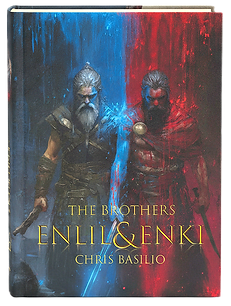
The Brothers: Enlil & Enki, especially:
Alulim–Marduk duel chapter in “Sacrifice” and surrounding sections (appearance of the Tablet, drain effects, transfer to Marduk).
Later chapter “The Right Stuff” and Act 6 scenes where Marduk partly transfers Tablet‑augmented strength to Enki and the Tablet dims.
Dalley, S., Myths from Mesopotamia: Creation, the Flood, Gilgamesh, and Others, Oxford University Press, 2008 (Enuma Elish and related myths on the Tablet of Destinies).
Foster, B. R., Before the Muses: An Anthology of Akkadian Literature, CDL Press, 2005 (Anzu myth translations).
Black, J. and Green, A., Gods, Demons and Symbols of Ancient Mesopotamia, University of Texas Press, 1992 (entry on Tablet of Destinies).



Comments