

Did the soup insult your family honor?
Evadine had not meant to cry over the lunch table.
It had been a long morning. Two planning calls. One dream‑check with Enki that turned into a lecture on Ley Line maintenance. Three emails from Beth, each more alarming than the last. By noon, her brain felt threadbare.
She carried her tray through the sanctuary mess hall and aimed for an empty corner.
Instead, she found Eddard already there.
He sat alone at a small table, suit jacket off, shirt sleeves rolled up, staring at a bowl of soup. The expression on his face suggested he was negotiating with it.
“You look distressed,” she said, stopping beside him. “Did the soup insult your family honor?”
He looked up, startled out of whatever thought loop he had fallen into. “It is cabbage,” he said. “I am adjusting my expectations.”
She glanced at her own tray. Bread, some sort of stew, one perfect mug of quantum coffee. “You are in a secret underground sanctuary and cabbage is your breaking point,” she said. “That feels on brand.”
He made room on the bench. “Sit,” he said. “Mock me properly. Standing is undignified.”
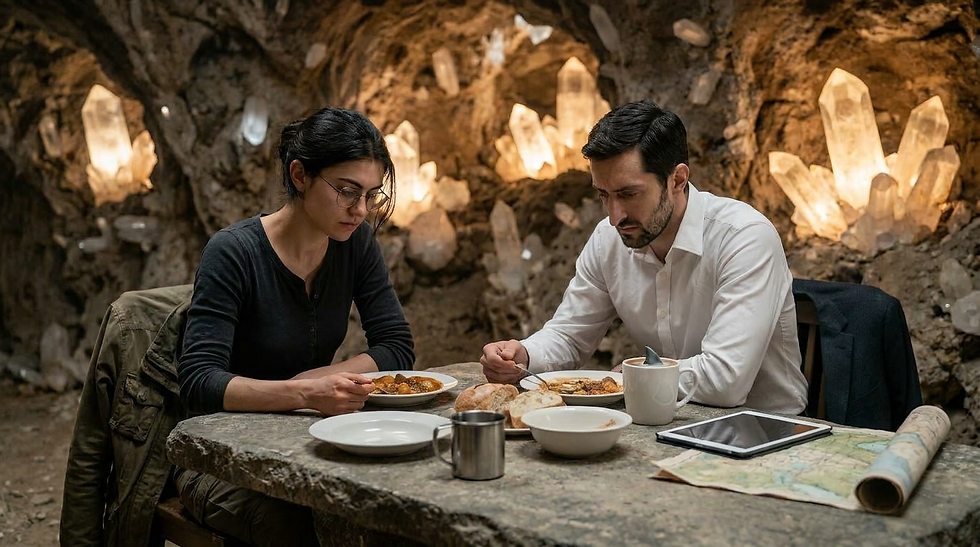
She sat. For a few minutes, they ate in silence. Conversations around them filled the space without intruding.
“Rough morning?” he asked.
“A bit,” she said. “Enki made me feel guilty about ignoring a collapsed tunnel in the Andes. Beth reminded me the rent on my old apartment is probably past due. And I had a thought about my cousin that will not go away.”
He waited.
“She sent me a text a week before I met you,” Evadine said. “Before any of this. It said, ‘If you ever start hiding from your life in your work again, I will show up and drag you out to breathe.’ I never answered. Then everything happened. Sanctuary. Flood threat. Ascension. I have not written back. She has no idea where I am.”
Eddard’s eyes softened. “You think she thinks you chose work over her again,” he said.
“She is not wrong,” Evadine said. “I worked and ghosted people who loved me.”
He watched her hands trace circles on the rim of her mug.
“Do you remember the first time you sent someone home?” he asked.
“In the sanctuary?” she asked.
He nodded.
She did. It had been a young man who insisted on joining a tunnel run three days after he arrived. His hands shook when he reached for the Field. His eyes had the hollow look of someone who had not slept since the last battle.
“He wanted to help,” she said. “He kept saying he had to prove himself. I told him no. That his job for that day was to sleep, drink water, and tell me three things he loved that had nothing to do with war.”
“And he hated you for it,” Eddard said.
“Probably,” she said. “He did not speak to me for a week.”
“You did that because you saw something he could not,” Eddard said. “You saw that if he went out there in that state, he would not come back. You do the same thing to yourself that he tried to do. You keep sending yourself on runs without rest.”
She looked at him. “Is this a pep talk from the man who negotiated global conflicts instead of going to therapy?” she asked.
“I never said I did it well,” he said. “I said I recognize the pattern.”
She stared into her soup.
“I do not know how to be half in,” she said. “If I step away, I feel guilty. If I stay, I feel worn out.”
A shadow loomed over their table. Evadine looked up.
Nurdu stood there, tray in hand, eyes taking in both of their faces.
“Is this seat taken?” he asked, nodding at the space beside Eddard.
“Yes,” Eddard and Evadine said together.
Nurdu set his tray down anyway and sat.
“I heard the phrase ‘worn out’ through the Field,” he said. “That is usually my cue.”
“Do you have little alerts set for emotional spirals?” Evadine asked.
“Yes,” he said.
He unfolded his napkin with more care than the action needed. “When I worked the Lines,” he said, “we thought there were only two settings. Work until you fall, or fail your brothers.”
“That sounds familiar,” Eddard said quietly.
“One cycle,” Nurdu continued, “we lost twelve in a single collapse. The ground took them. The Lines flared. Those of us who survived came back up. The next morning, one of the younger Igigi came to me and said he wanted to go right back down.”
“Sound judgment was not in high supply,” Evadne said.
Nurdu shook his head. “He said, ‘If I stop, I will think. If I think, I will break.’ I told him, ‘If you do not stop, you will break anyway, and you will do it on top of someone who needs you steady.’”
“What did he do?” Eddard asked.
“He slept,” Nurdu said. “For thirty hours. When he woke up, he cried for the first time since the collapse. Then he went back down. He did not fall on anyone.”
He slurped a spoonful of soup.
“The Field does not reward those who grind themselves to dust,” he said. “Dust cannot stand. You two do work that touches many Lines. That does not mean you skip mourning, rest, or joy. If you do, you chip at the very thing you are trying to prove: that humans can carry divinity without losing themselves.”
Evadine pressed her lips together. “One of my texts is still sitting there,” she said. “Unread. On purpose. Because if I read it, I will feel how much my cousin misses me. And then I will fold. And maybe not come back to this table.”
Nurdu nodded. “Then send her a message from this table,” he said. “Not the whole truth. Enough truth. Tell her you are doing something hard and you love her. Then, when you are able, tell her more. You do not have to choose between saving the world and sending one text.”
Eddard stared at his soup.
“You have someone too,” Nurdu said.
Eddard did not answer at once. Then he said, “Beth keeps a burner phone in her kitchen drawer. For emergencies. I have her number memorized. I have not picked it up since this began.”
“You worry she will try to pull you off the board,” Evadine said.
“I worry she will hear the tremor in my voice,” he said. “And know I am afraid.”
“Then let her,” Nurdu said. “She has earned that much. You do not need to tell her everything. Only that you are still here. Still fighting. Still grateful she exists.”
He took another spoonful.
“We all lost more than we can count,” he said. “But we also still have people who remember who we were before we became our roles. Those people are anchors.”
The three of them sat in quiet for a moment.
The mess hall noise carried on around them. Someone burst out laughing at a joke across the room. A child ran past chasing a ball. The world did not stop.
Evadine pulled her phone out of her pocket. She did not get a signal down here, but the message app opened all the same. A draft thread waited. Her cousin’s name sat at the top.
She started typing.
Hey. This will show up from a weird number and probably at the worst time, but I wanted you to know I am alive. I did not disappear because of work this time. Well, I did. But it is complicated. I love you. I am doing something hard. When this is over, I will come find you and let you yell at me. Please keep breathing.
She stared at the screen.
“That is not enough,” she said.
“It is more than silence,” Nurdu said. “The rest can come in chapters.”
Eddard watched her thumb hover, then hit send.
The phone spun a little wheel as it stored the message for later delivery.
He took out his own device. It looked almost out of place on the stone table.
He opened a contact labeled only “H.”
He typed.
Unscheduled update. Still here. Working. I do not deserve the loyalty you have given my family, but I am finally doing something that might be worth it. Do not reply to this until it is safe. I just wanted you to know you were right about me needing to work toward something other than our bottom line.
He paused, then added:
Also, you were right about the meditation. It is saving my life.
He saved it in drafts.
“Baby steps,” he said.
Nurdu finished his soup. “Remember this,” he said, standing. “Every time you choose to reach out to someone who loves you, you prove my people did not suffer in vain. We held the Lines so there would still be days where someone could sit in a hall, eat bad cabbage, and decide to send a message instead of disappearing.”
He walked away without waiting for a reply.
Evadine and Eddard sat at the little table, phones between them, soup cooling.
“You know this would fit in a Self-Help book,” she said. “Underground edition.”
“Chicken soup for the soldiers at the front,” he said.
“Volume one,” she replied.
They picked up their spoons. The cabbage still tasted like cabbage, but it also tasted of something else now.
They were not only fighting. They were still capable of reaching out. Of being reached. Of being human.


Comments