

Nephilim
Updated: Apr 9
Evadine had banned meetings in the war rooms for the night.
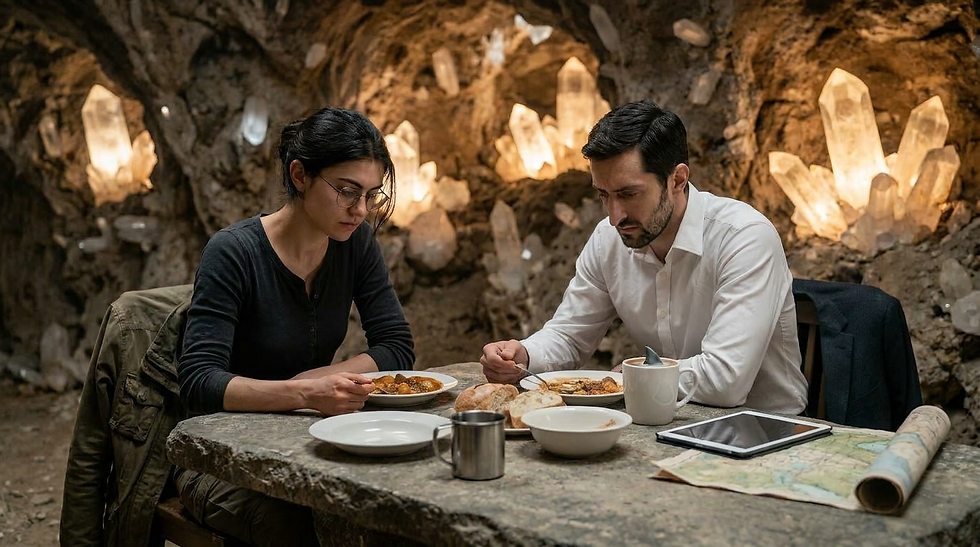
The sanctuary kitchen held better lighting and better coffee. Pots clinked in the background as Juliana’s replacement prepped bread for the next day. A faint vibration came from the tunnels where Igigi drills continued. The rest of the Ascended kept a respectful distance from the corner table where Enki and Evadine sat.
Her laptop rested on the table. A document title blinked.
Nephilim: A Field Report
“You really want that word in the heading,” Enki said.
“It gets clicks,” Evadine replied. “Also, it is accurate.”
“It also gives certain Anunnaki hives,” he said.
“Those certain Anunnaki already dissolve in the Womb or sit in therapy,” she replied. “We are past that. Start talking.”
“You have the gossip version,” he said. “Fallen ones. Great heroes. Great disasters. Which epic do you want?”
“The honest one,” she said. “You narrate. I translate. We argue over the parts where Enlil looked worse than usual.”
“That is most of it,” Enki said.
“Then we have a long night,” she said.
He wrapped his hands around his mug. “Then we begin after your Flood,” he said. “Most of them died then. Some did not. Their children did not either. That will surprise the ones who think history drew a neat line there.”
She lifted her mug in a half‑salute. “To messy lines,” she said. “Go.”
***
The boy had his father’s height and his mother’s eyes.
He stood at the edge of a new field. Mud clung to his ankles. The water from the last storm still sat in shallow channels. The soil smelled raw. In the distance, a half‑collapsed wall marked where the old city had ended before the water came.
He pressed his heel into the ground. It held.
Behind him, four families watched and waited. Their huts were new. Poles still bent under the weight of fresh roofs. Smoke rose from one small fire.
“Here,” he said. “We plant here.”
“You said that last time,” a woman answered. She held a sleeping baby in one arm. “Then the river took half of it.”
“The river took the low part,” he said. He pointed to the slope where new reeds already grew. “We plant where the ground does not sigh when you step on it.”
She frowned. “How do you know when it sighs?” she asked.
He looked at her husband’s boots. Mud cracked along the sides. “Your soles forgot,” he said. “Mine did not.”
He walked the boundary of the field. Each step measured the give in the earth. He marked the soft spots and told the children to avoid them.
“What was his name?” Evadine asked.
“Benayot,” Enki said. “Son of no record on any official tablet. His mother had been a baker’s daughter. His father had visited at night and never claimed him in the Assembly.”
“Anunnaki father,” Evadine said.
“Yes,” Enki said. “One of the lesser ones who thought rules were suggestions. The kind who made Enlil grind his teeth.”
“Good,” she said. “We can blame him for this later.”
Benayot’s shoulders sat higher than the men who argued with him. When he straightened to stretch his back, his head rose above the nearest hut. He ducked when he stepped through doorframes without thinking. He had already broken three lintels in the old settlement before they rebuilt here.
Children watched him at the edges of their games. Some copied his long stride. Others avoided standing beside him for fear of being seen as different.
He carried more jars than anyone else. He lifted beams no one else could lift. When he laughed, sound filled the yard.
At night, his knees ached.
He sat on a flat stone near the new fire pit and rubbed his joints. The skin around them felt too tight.
His mother sat beside him. Her hands were rough from kneading dough. She watched his face.
“You did well today,” she said.
“We did not sink,” he said.
“Do you doubt yourself?” she asked.
He pulled a twig from the ground and snapped it in half. “I doubt the ground,” he said. “And the sky. And the river. The only thing I do not doubt is that you will need more bread tomorrow.”
She smiled. “Bread is a simple thing,” she said. “Water, ground seed, time, heat.”
He looked at his long fingers. “I am not a simple thing,” he said.
“No,” she said. “You are water, ground seed, time, heat, and a father who thinks he can hide behind shadows.”
He looked up sharply. “You saw him?” he asked.
“I felt him,” she said. “When you were born, you did not come out alone. The air bent around you. The midwife fainted. Your father stepped back into the Field and vanished. The house smelled of storm and stone for three days.”
“She talked about it that calmly?” Evadine asked.
“By then she had survived the waters,” Enki said. “A disappearing visitor was less impressive.”
Benayot stared at the fire. “So I am half of him and half of you,” he said.
“You are all of you,” she said. “You are not a fraction of someone who did not stay.”
“You make it sound simple,” he said.
“It is simple for me,” she said. “I only have one son to feed. You have the harder part. You must decide what to do with your size.”
He looked at his hands again. “I can lift,” he said. “I can build. I can break.”
“You can choose,” she said.
***
“Did you watch him?” Evadine asked.
“From higher ground,” Enki said. “He fascinated me. Not only for the obvious reason. He had his father’s reach into the Field but had no instruction. He did everything by instinct.”
“Which father?” she asked. “You knew which one?”
Enki nodded. “I will not name him,” he said. “He paid his own price later. For this story, his absence matters more than his identity.”
“Very generous,” Evadine said.
Benayot’s first reach into the Field happened when a roof beam slipped.
A storm had rolled in. Wind drove rain across the clearing. The new huts creaked. One beam on the nearest roof had not settled into its notch. Water soaked the lashings.
Thunder shook the air. The beam slid.
A child stood under it.
Benayot moved before anyone else saw. He grabbed the air.
The beam halted above the child’s head. No rope held it. No hand touched it.
Benayot’s fingers trembled in empty space.
He felt resistance where there should have been none. The Field bent around his intent. The beam shuddered and sagged. He stepped forward and shoved it back into place.
It slammed into the notch and stayed.
The child stared up, then at Benayot.
“How did you do that?” the child asked.
Benayot stared at his own hand. Droplets of water hung in the air around it, suspended in an arc that defied the rain’s direction.
“I do not know,” he said.
He released his grip on the Field. The water line fell. The storm resumed its pattern. His knuckles ached.
“Untrained telekinesis,” Evadine said. “Fun.”
“Dangerous,” Enki said. “He could have ripped the beam in half and brought the roof down on both of them. Three of my early Nephilim did that. They did not live long.”
“What did the villagers do?” she asked.
“They whispered,” Enki said. “Some whispered fear. Some whispered awe. Some whispered gossip. It spread faster than the flu you had in college.”
“You were not supposed to see that,” she said.
“I saw that,” he said.
***
Word traveled farther than the cleared hill.

Travelers who passed through the region carried stories of a young man who held beams in midair and lifted carts alone. They also carried stories of other Nephilim in other valleys.
Not all used their strength as Benayot did.
“Here we go,” Evadine said.
Enki nodded. “Here we go,” he said.
In a valley to the north, three Nephilim brothers decided the world owed them compensation.
Their father had been a Higher Anunnaki who had left them nothing except a tendency to survive wounds that killed their companions. Their mother had died early. Villagers had used their strength and kept their distance.
They grew into men who could wrestle bulls to the ground. They could dam streams with fallen trees and move those trees on their own. They realized early that people stepped out of their way in alleys.
They called themselves rulers. No one had given them that title.
At first, they demanded tribute from caravans in the form of food and coin. Then they demanded daughters. Then they demanded worship.
“They started carving their faces into cliff walls,” Enki said. “That part was new. Even we had not tried that.”
“Ancient billboards,” Evadine said. “All they needed was a toll‑free number.”
“They had messengers,” Enki said. “Their behavior drew attention fast.”
Enlil reviewed reports.
He stood before a projection of the valley, arms folded. Data from watchers and Field readings hovered in front of him.
“They are destabilizing three districts,” Nur‑Kar told him. “Trade routes divert to avoid them. Crop collection patterns shift. Local militias form around them. The Lines under that region have begun to oscillate at frequencies that concern me.”
Enlil’s jaw clenched. “This is what I warned about,” he said. “Seed strength in flesh that cannot carry it and you get a fracture.”
“Not all Nephilim do this,” Sagar said from the side. “Benayot and others build instead of tear down.”
“Benayot and others do not reach as far as these three,” Enlil said. “The brothers are children of a Higher Anunnaki. Their reach in the Field exceeds what any human around them can counter. They bend the local Lines when they stomp their feet.”
Sagar met his gaze. “They also carry some of our responsibility,” he said. “We made promises to adjust the design. We punished Enki. We did not erase the ones already born. They are the loose ends of our decree.”
“Loose ends that strangle villages,” Enlil said.
Nur‑Kar spoke carefully. “The charter forbids direct elimination,” he said. “We can isolate them. Cut their access to Field reservoirs. Starve their power.”
Enlil turned to him. “And leave three half‑feral giants until they die of old age while they keep stamping on everyone around them,” he said. “No.”
“You want a culling,” Sagar said.
“I want a correction,” Enlil said. “Targeted. Surgical. We owe the Field that.”
He looked toward the Womb, though he did not move his feet.
“We also owe honesty,” he said. “We created Nephilim through broken vows. We tried to bury them in your Flood. Those who survived carry that wound. We either own it and fix it, or we leave it for someone else to bleed from later.” He felt the familiar anger at Enki’s design choices and at his own signed votes.
“We are past the Great Flood,” Evadine said. “He grew from ‘kill them all’ to ‘kill some of them’.”
“It took him ages,” Enki said. “You are not wrong. Yet this was more nuance than some of his supporters expected.”
“What did you do?” she asked.
“I argued to keep the ones who were building and teaching,” Enki said. “He agreed for once.”
“You actually agreed on something,” she said. “Historic.”
“We even drank to it,” Enki said. “One night. No one believes me when I say that.”
***
The purge of the worst Nephilim took several human generations.
Anunnaki moved through the Field, not through the streets. They dismantled structures that served oppression. They disrupted power flows where Nephilim had tied their reach into old reservoirs. They turned a few displays of cruelty back on their wielders.
A Nephilim woman who had strangled dissent by choking the river that served three villages woke one morning to find her own access to water gone. When she reached for the Field to pull moisture from the air, she found only dry stone. Her body aged in weeks. The villages she had starved scattered.
A man who had commanded worship on pain of broken bones found his grip gone while he tried to crush another’s hand. The Field under his feet dropped. He fell into a sinkhole his endless stomping had created.
Others saw these falls and backed away from similar behavior. Some repented. Some fled to remote mountains and lived out their long lives in isolation.
Not all Nephilim faced that end.
Benayot built.
He learned to treat his aches using herbs Ina discovered. He taught younger ones to lift in ways that spread the strain. He learned to listen to the Field more gently.
When drought came, he did not demand sacrifice. He followed the old channels Sansuna had marked in her time. He told his people to move uphill ahead of the worst.
When bandits from the valley tried to raid the hill settlement, he stood alone on the path.
“Turn,” he said.
They laughed and raised their weapons.
He bent the wind.
Dust filled their eyes. Their horses reared. Their arrows fell short. The men who came to break huts turned their mounts and fled.
Children watched from behind their parents. They saw his height, his reach, his restraint. They whispered the word Nephilim as a warning and a comfort at once.
“They were not all monsters,” Evadine said. “The old texts only kept the worst.”
“Fear edits hard,” Enki said. “Many human scribes served kings who needed simple lines. Strong beings from the past made convenient villains for dark ages. The ones who helped did not fit an easy narrative.”
“Then we give them one,” she said. “We can afford complex stories now.”
***
Centuries later, when most Nephilim had died or faded from record, their traces remained.
In one region, farmers still refused to plant on a strip of land that never sank. Oral stories told of a tall ancestor who had stomped the ground there for days until it settled. No one remembered his name. Everyone trusted his work.
In another region, healers taught a method of bracing joints passed down through midwives from Ina’s line. They remembered a big man who complained of knee pain and did not complain again after Ina changed his regimen. They did not have the genealogy. They had the practice.
In a hill village far from any river, children repeated a rule. Do not make others kneel when you stand taller than them. The adults could not trace its origin. A story slumbered under it of a Nephilim who had practiced forced kneeling and had vanished into a storm.
“You are saying Nephilim became ethics,” Evadine said.
“In some places,” Enki said. “In others, they became ghosts and warnings. Humans carried both in blood and story.”
“You sound almost proud,” she said.
“I am proud of the few who managed to be better than their design and their resentment,” he said. “They had reasons to burn everything. Some chose to build instead. That weighs more to me than all the stone faces carved on cliff walls.”
She sat back. “So the epic of Nephilim is not that they were huge. It is that they had too much power for their support structure and did not all implode.”
“Yes,” Enki said. “That is one way to put it.”
She glanced at him. “Remind you of anyone?” she asked.
His gaze met hers. “You,” he said. “Your Ascended. Those who reach into the Field without crumbling the rest of us.”
She rolled her eyes to cut the weight of the moment. “We have better joint care,” she said. “And therapy. And coffee.”
“And a scribe who does not let us hide our mistakes,” he said.
“Speaking of,” she said. “You skipped one thing. You said some Nephilim children survived the Flood. What happened to their lines?”
He lifted his mug. “You met one last week,” he said. “He did not know. His knees ached more than they should at his age. He stood in front of a door when a blast came. The Field bent around him in a way that looked very familiar.”
“Marcus,” she said.
Enki nodded. “Mixed lineage. Human on all official records. A thin thread of Nephilim way back. Enough to give him that extra moment of steadiness when others would have fallen.”
“He will hate that,” she said. “He already fights the idea that he is not fully human.”
“Then do not tell him until he is ready,” Enki said. “Or never. His choices matter more than his ancestry.”
She looked at her screen. The document had grown. Names and places filled it. Benayot. Ina. Anonymous brothers who fell. Hills where no one built wrong twice. Edits waited, but the shape of the epic stood.
“You think if we release this, humans will stop using Nephilim as shorthand for evil giants?” she asked.
“No,” Enki said. “Not at once. But a few will read. A few will see themselves in the ones who chose better. A few will notice when their knees ache and wonder what else they carry.”
“Subtle,” she said. “We can work with that.”
He watched her fingers hover over the keys.
“You will keep the jokes?” he asked.
“Yes,” she said. “The world has enough grim epics. It can handle one where tall people get joint care and emotional arcs.”
Enki took another drink of coffee. “Then write it,” he said. “Before I change my mind and start deleting paragraphs.”
She started typing again.


Comments