

Great Deluge
Updated: Mar 8
Summary
The Great Deluge is the engineered comet impact and global flood event that ended the pre‑Deluge human age, erased most surface civilisation, damaged Earth’s Ley Line network, and forced the Anunnaki retreat into the Womb of Creation; later human cultures preserved fragmentary records of this event as the Flood.

Overview
The Great Deluge is a coordinated extinction‑scale intervention in which Enlil ordered Utu’s sun‑ship to redirect a large comet into Earth. The impact into northern ice sheets generated extreme thermal, seismic, and hydrological effects that drowned or destroyed most pre‑Deluge human settlements and many animal populations.
From the Anunnaki perspective the Deluge served several purposes: termination of uncontrolled Nephilim breeding, removal of human populations judged non‑compliant, and reduction of Field strain from overused Ley Lines and industrial activity. From the human perspective it appeared as sudden global catastrophe that submerged cities, plains, and coastal regions and ended entire cultures inside a short span.
The event remains a central reference point in later Assembly debates about stewardship, culling, and the rights of created species.
Details
Mechanism
Enlil presented the Deluge as a necessary corrective to Field imbalance and human transgression.
Utu commanded a war‑configured starship that used tuned sonic and Field harmonics to lock onto a comet’s frequency and alter its trajectory.
The ship emitted a non‑visible Field beam that collapsed the range of outcomes into a single impact solution.
The chosen solution drove major fragments into northern ice shields and adjacent crust rather than deep ocean, maximising atmospheric dust, meltwater release, and shock coupling into continental plates.
Physical effects
Primary impact vaporised rock, ice, and biomass at ground zero, leaving no intact remains inside the core blast region.
Secondary fragments struck additional ice fields and landmasses, producing multiple craters and widespread ejecta.
Thermal radiation fronts ignited vegetation and heated surface waters; shock waves generated continent‑scale earthquakes and landslides.
Meltwater pulses and impact‑driven ocean displacement produced mega tsunami events that propagated across basins and overran coasts far from the impact site.
Atmospheric loading by dust and aerosols altered solar input for an extended period, disrupting climate and seasonal cycles.
Biological and societal effects
Large fractions of megafauna died through direct thermal effects, drowning, starvation, or rapid habitat loss.
Human mortality reached extreme levels; only scattered groups on high ground, in protected gorges, caverns, or craft survived.
Complex settlements, irrigation systems, and early urban centres vanished; knowledge chains broke where entire clans, scribes, or priestly orders perished.
Genetic diversity among humans and domestic animals contracted sharply, which later myth encoded as “pairs” on arks or protected enclosures.
Technological and Field aspects
Anunnaki assets on or near Earth experienced severe damage to surface facilities and atmospheric platforms.
Igigi mining operations in high‑risk zones ceased; many shafts collapsed or flooded.
Ley Lines paused flow briefly at the moment of impact, then resumed at reduced capacity; several named segments entered long‑term dysfunction.
On a command vessel in orbit, Enki recorded full pre‑impact DNA diversity into a fused silica‑dominant crystal artefact, preserving a genomic snapshot that served as insurance against total biosphere loss.
History
Pre‑Deluge conditions
Long before the Deluge, Anunnaki activities on Earth had altered planetary systems:
Extensive Ley Line tapping by Igigi and later by humans stressed energy channels.
Human populations increased beyond initial design tolerances, especially in regions where Nephilim hybrids appeared due to prohibited unions between Anunnaki and humans.
Enlil and allied warlords interpreted these developments as threats to Anunnaki control and Field stability.
Assembly debates recorded divergent views: Enlil argued for decisive culling; Enki advocated reform, tighter guidance, and non‑terminal interventions. The Assembly ultimately authorised Enlil’s solution.
Execution
On Enlil’s order:
Utu deployed a sun‑ship equipped for Field‑harmonic targeting.
The crew matched the ship’s harmonics to the comet’s Field signature until resonance locked.
A directed Field beam collapsed probability such that impact occurred at a predetermined sector on Earth’s surface.
Enki, present in astral form, attempted to halt the sequence but held no command authority and could not override ship protocols.
Enki experienced the whole chain through Field memory in later self‑imposed purgatory, reliving the approach, impact, and ground effects repeatedly.
Impact and flood phase
After atmospheric entry:
Initial fragment strikes into ice and shallow crust produced fireballs and blast waves that removed all structure in wide radii.
Subsequent interactions between meltwater, ocean basins, and tectonic adjustments generated prolonged flooding and storm activity.
One recorded survival case involves Sansuna, a half‑Anunnaki giantess, who shielded her human ward Splotch in a rock fissure and later a hardened pouch during the shock and flood phases, preserving a single human lineage that still carried her final injunction: “Live. Make your mark. Do not forget.”
In many other regions no such protection occurred.
Immediate aftermath
Once the main flood pulses receded:
Landforms had shifted, river courses had changed, and sediment layers had buried prior constructions.
Surviving humans faced stripped landscapes, reduced game, and unstable climates.
Anunnaki assessed the cost and found that, although the Deluge removed many targets, it also caused long‑term damage to Earth’s infrastructure and to trust inside their own ranks.
Enki’s shame and grief deepened. His personal creed around “Honor and Sacrifice” changed definition at this stage from justification for mass actions to responsibility for those harmed by such decisions.
Long‑term consequences
Retreat to the Womb
The Deluge and cumulative Ley Line damage contributed to the Assembly’s decision to suspend operations and enter the Womb of Creation. The plan used stasis to give Earth time to stabilise environmentally and energetically.
Human myth formation
Surviving human communities transmitted narratives of a global flood, select survivors, divine judgment, and post‑flood covenants. These narratives later appeared in:
Mesopotamian texts, including the Utnapishtim episode in the Epic of Gilgamesh
Hebrew texts, notably Genesis 6‑9
Many other flood traditions on multiple continents
Post‑Deluge control systems
After waters receded sufficiently and new human cultures began to rise, Enlil established human proxy lines such as the Roycemonts to steer societies through war, scarcity, and division, reducing the probability that humans rediscovered their full divinity and the true history of the Deluge.
The Great Deluge remained the definitive example cited by Enki when he later resolved never again to allow an extinction‑scale cleansing without direct opposition, leading to his counter‑phase work in the Womb and his mentorship of Ascended humans.
Notes
In‑universe chronology places the Great Deluge after extended Igigi operations and before the Womb retreat; human chronologies that synchronise it only to a single local flood underestimate its global scope.
The event did not remove all humans or Nephilim; it reduced numbers to scattered survivors, from which later populations expanded.
Many post‑Deluge divine prohibitions and mandates recorded in human scriptures correspond to Anunnaki policy decisions regarding breeding control, Field usage, and access to knowledge.
Enki’s crystal archive of DNA does not directly correspond to any single human artefact in later myth; it functioned as Anunnaki emergency backup rather than a physical “ark” for humans to board.
The term “Great Deluge” covers the entire engineered sequence: comet steering, impact, global flood, and immediate restructuring of Anunnaki‑human relations.
Citations
Epic of Gilgamesh, Tablet XI (standard Babylonian version), cuneiform flood narrative from ancient Mesopotamia.
The Hebrew Bible, Genesis 6–9, flood narrative in the Masoretic Text.
Firestone, R. B., et al., “Evidence for an extraterrestrial impact 12,900 years ago that contributed to the megafaunal extinctions and the Younger Dryas cooling,” Proceedings of the National Academy of Sciences, 104(41), 2007.
Dundes, A. (ed.), The Flood Myth, University of California Press, 1988.
Heine, A., Waterworld and Other Worst Case Scenarios, 2011
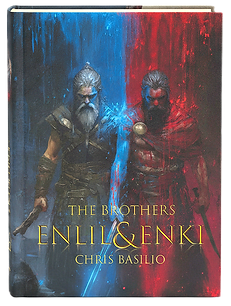
Internal Anunnaki and Igigi records as presented in The Brothers: Enlil & Enki (in‑universe primary narrative source).



Comments