

Enlil
Updated: Mar 22

Summary
Enlil is a Higher Anunnaki, lord of air and command, mission leader for Earth operations, and principal advocate for culling humans. He embodies strict enforcement of order and the creed “Honor and Sacrifice” until his final act, where he enters a Field fracture to stabilise reality and open the Assembly to humanity.
Overview
Enlil holds one of the highest ranks among the Anunnaki. Anu appoints him to lead the Earth resource mission, command warhosts, and enforce Assembly mandates. He controls atmospheric and storm phenomena, directs large‑scale Field operations, and holds the authority to order events such as the Great Deluge.
He values obedience, hierarchy, and predictability. He distrusts rapidly developing subordinate species, in particular the Igigi and later humans. His decisions frequently favour decisive elimination of perceived threats rather than incremental adjustment.
Despite harsh policies, Enlil does not view himself as cruel. He believes his role demands hard choices to protect Anunnaki civilisation and the Field. His relationship having Enki begins in deep affection and shared youth and later deteriorates into ideological conflict over justice and stewardship.
In the current cycle he acts as antagonist to human ascension and Enki’s reforms, but his final decision in the Mount Rainier battle redefines “Honor and Sacrifice” and prevents Field collapse.
Details
Abilities
Command over air and storms
Generates and directs lightning, wind, and pressure fronts.
Uses atmospheric systems for strategic signalling and as weapons.
High‑level Quantum Field manipulation
Alters trajectories of comets through harmonic locking via subordinate vessels.
Executes high‑order techniques such as the Hammering of the Forge, a multi‑step killing sequence.
Imposes global counter‑phases on dormant Anunnaki to force awakening at personal cost.
Leadership and organisation
Structures warhosts into effective formations.
Maintains discipline across Higher, Lesser Anunnaki, and Igigi.
Uses the creed “Honor and Sacrifice” to bind orders.
Personality and ethics
Prioritises order over individual welfare.
Views disobedience as direct threat to Field and Assembly.
Shows capacity for affection and humour in private, particularly toward Enki and Marduk, but suppresses those responses during command.
Interprets “Sacrifice” primarily as cost borne by those assigned to tasks rather than by issuing lords until late in the narrative.
Displays genuine remorse at key moments, especially around Enki’s apparent death and his own recognition that repeated cullings cannot continue.
Relationships
Anu
Shows respect and deferential obedience.
Acts as executor of Anu’s decisions, even when applications are severe.
Enki
Younger brother during early scenes; partner in mischief and training.
Later a rival in policy debates and moral outlook.
Enlil never fully loses his bond to Enki; grief during their final duel demonstrates that emotional connection persists under conflict.
Igigi
Views them as workforce and lower‑tier Anunnaki.
Resents their rebellion and uses it as justification for tight control over replacement species.
Applies the creed over their deaths in Ley Line work but often fails to internalise the cost.
Humans
Accepts their creation under Assembly pressure but demands strict limitations and controls.
Orders adjustments to reduce stature, shorten lifespan, and constrain divinity expression.
After the Deluge and Womb retreat, installs human proxies (Roycemonts) to keep humanity divided and distracted.
Roycemont line
Selects the first Roycemont as human agent, kills part of his family to enforce loyalty, brands the surviving child’s bloodline for favour and mandate.
Over time his involvement becomes indirect, while later Roycemonts forget the original divine context.
History
Early life and separation from Enki
Enlil and Enki spend early cycles in Anu’s palace:
They steal a training Tablet of Remembrance, reprogram fountains, and trigger archive flooding.
Anu punishes them through labour and eventually separates them for advanced training: Enlil to command and war, Enki to creation and science.
Enlil’s training includes brutal drills, an altar ritual where the Field burns away potential futures, and long duty in the Hall of Minor Powers, judging trivial disputes until attachment to individual outcomes dulls.
These experiences shape Enlil into a strict, duty‑centred commander.
Appointment to Earth mission
When Anu seeks off‑world resources for Anunnaki civilisation:
He assigns Enlil to lead the Earth mission.
Enlil receives authority over military, administrative, and extraction structures.
Enki becomes chief scientist, tasked to design procedures and technologies, and to advise on planetary conditions.
Enlil’s focus is delivery of resources on schedule and containment of subordinate unrest.
Igigi exploitation and rebellion
Under Enlil’s command:
Igigi work dangerous Ley Line shafts and Subterranean Crystalline Caverns.
Accidents dismember, crush, or burn many workers.
Calls for improved safety often clash against production targets.
Nurdu and Alulim lead Igigi protests and eventually armed revolt:
Igigi march on Enlil’s command centre and lay siege.
Enlil frames the uprising as breach of “Honor and Sacrifice”.
He favours suppression through force over structural change.
The conflict escalates into civil war between Higher Anunnaki and Igigi‑aligned forces.
Human creation and the Alulim–Marduk duel
To replace Igigi in lethal roles:
Enki proposes transformed terrestrial bipeds through infusion of Anunnaki and Igigi divinity.
Enlil warns that any strong workforce will rebel as Igigi did.
The Assembly orders a duel to resolve the crisis:
Marduk fights for Higher Anunnaki; Alulim fights for Igigi.
Both invoke “Honor and Sacrifice” before combat.
Marduk kills Alulim and inherits the Tablet of Destinies.
Enlil uses the outcome to justify:
Creation of humans using Alulim’s blood.
Strict constraints: smaller bodies, shorter lives, reduced direct access to the Field.
Ending of Igigi labour in the most dangerous shafts.
He later discovers Enki’s hidden divinity code in human DNA and erases the index that would have exposed the act, choosing to keep the secret and instead commit to preventing humans from ever activating it.
The Great Deluge
As human populations grow and Nephilim appear through unauthorised unions:
Enlil concludes that humans have exceeded their designed role.
He argues that unchecked numbers and hybridisation threaten Field balance and Anunnaki control.
The Assembly authorises his plan to redirect a comet into Earth.
He orders Utu’s ship to execute the strike:
Sonic and Field harmonics lock onto comet frequency.
A Field beam collapses its trajectory into an impact that triggers the Great Deluge.
Almost all surface civilisations and many species die in the flood.
Enlil invokes “Honor and Sacrifice” to carry the decision as necessary. The event later becomes central in Enki’s determination never to repeat such an act.
Womb retreat and Roycemont mandate
After prolonged exploitation and the Deluge:
Anu calls for withdrawal into the Womb of Creation.
Enlil accepts on the understanding that operations will resume when Ley Lines recover.
Before full retreat:
He selects a human family (Roycemonts) and grants them wealth and influence under condition that they keep humanity fragmented.
He seals their bloodline through a Field mark that biases fortune and access.
He explains their duty in the creed’s terms, though later generations forget the divine origin and act only to maintain power.
Inside the Womb, Enki imposes a counter‑phase that holds all Anunnaki longer. Enlil detects this but allows the secret to stand to avoid bringing Assembly scrutiny on his brother, deciding instead to block any human awakening.
Forced awakening and renewed Assembly
As Earth recovers and human technology advances toward Field understanding:
Enlil senses risk of uncontrolled human ascension.
He pushes against the Womb’s resistance and eventually tears himself free.
To wake others he performs a high‑cost ritual, tearing fragments of his own divinity and forcing them into dormant Anunnaki.
This sacrificial act leaves him weakened and aged in Field terms but wins loyalty from many warlords and lesser lords.
He calls a new Assembly:
Presents humans as repeating Igigi errors at larger scale.
Argues that Enki’s actions constitute treason against Anunnaki.
Secures a majority vote for human culling.
During the Assembly, Evadine stabilises his failing divinity by pouring her own Field strength into him. He privately notes this but holds to his policy.
War against Enki, Igigi, and Ascended
After the culling vote:
Enlil mobilises forces to seize and hold key Ley Line taps.
He uses Roycemont networks to trigger wars and technologies that advance his ends.
He views Ascended humans as direct violations of prior containment and targets them accordingly.
On the ground:
His warlords deploy new Field‑nullifying technologies against Marduk’s Tablet and Ascended maneuvers.
He uses severe tactics during battles in tunnels and caverns, including lethal demonstrations aimed at breaking human morale.
Despite these, Enki, Igigi, and Ascended teams disrupt many operations through probability work and careful tap sabotage.
Final duel and self‑sacrifice
The conflict culminates under Mount Rainier:
Enlil enters the primary collection facility, expecting minimal opposition, but finds Enki’s forces and Ascended converging.
He and Enki agree that their confrontation cannot be avoided, invoke “Honor and Sacrifice”, and fight a high‑intensity duel using hammer and daggers plus Field techniques.
The duel pushes both toward collapse; Enki repeatedly diverts killing blows into the Field rather than returning them.
At the peak of strain:
A Field fracture opens, a tear in underlying structure that threatens planetary and wider stability.
Enki prepares to step into it to atone for past decisions.
Enlil instead steps forward, drops his claim to leadership, and enters the fracture.
His divinity disperses into the Field and stabilises the damaged region. Nurdu recognises this as the highest fulfilment of “Honor and Sacrifice”. The Assembly then accepts humanity into its ranks, a decision Enlil’s act makes possible.
Notes
In Mesopotamian tradition Enlil is storm and air deity, king of gods, and source of many flood narratives; the series preserves these functions and translates them into Field and command roles.
His early decision to hide Enki’s genetic “crime” and instead manage humans indirectly marks a fork where he chooses personal loyalty over strict legalism, but then doubles down on control.
His forced awakening of the pantheon is both treason against the Womb’s timing and genuine Sacrifice in service of his reading of duty.
Enlil’s final entry into the Field fracture reorients the creed from tool of justification to standard for leadership, demonstrating that higher tiers must eventually bear the cost they impose.
Citations
Codex entry Enlil (in‑setting character profile).
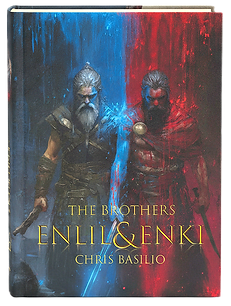
The Brothers: Enlil & Enki, especially:
Act 1, “Immortal Sin” (comet steering and Great Deluge).
Act 2, Enlil‑focused chapters “The Withering,” “Hidden Until It Wasn't,” “The Last Anunnaki,” and “The Mandate” (Womb, Roycemonts).
Act 4, “Waking The Storm,” “Becoming Human,” and later battle chapters (forced awakening, surveillance of Enki and Evadine, war conduct).
Act 6, “The Brothers: Enlil Against Enki” and “Sacrifice” (final duel and Field entry).
ETCSL, hymns and myths to Enlil (for traditional roles and titles, e.g., “lord of the air” and rulership).
Lambert, W. G., Babylonian Creation Myths, Eisenbrauns, 2013.
Dalley, S., Myths from Mesopotamia: Creation, the Flood, Gilgamesh, and Others, Oxford University Press, 2008.



Comments